
 Product Video
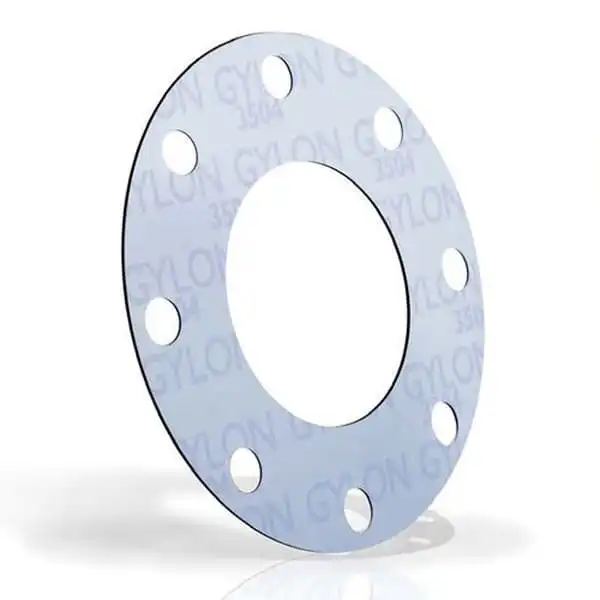
What is Garlock GYLON® Style 3504?
Garlock GYLON® Style 3504 is a modified PTFE sheet gasket filled with aluminosilicate microspheres, engineered to overcome the typical limitations of virgin PTFE in terms of creep and cold flow. The material is designed to provide improved dimensional stability, enhanced elastic recovery, and more reliable long-term sealing performance, even under thermal cycling and load fluctuations.
Compared to traditional PTFE, GYLON® 3504 delivers a more controlled mechanical response under compression, reducing relaxation over time and maintaining consistent surface pressure on the flange. This results in fewer bolt re-tightening interventions and improved operational safety.
Technical characteristics and operating limits
From an operational standpoint, GYLON® Style 3504 performs across an extremely wide temperature range, from -268°C up to +260°C, with an ideal continuous service limit of +204°C. It is suitable for full vacuum applications and can operate up to a maximum pressure of 55 bar, with an ideal recommended limit of 52 bar.
The maximum PxT value reaches 350,000 (psig × °F) for 1/32” and 1/16” thicknesses, making the material suitable for numerous industrial applications requiring a balanced combination of pressure and temperature resistance.
Design factors according to ASTM F586 indicate an m factor of 3.0 for thicknesses up to 1/16” and 2.5 for 1/8”, with corresponding y factors of 1650 psi and 3000 psi. ROTT gasket constants confirm reliable sealing performance even under dynamic loading conditions.
The material does not support flame propagation and does not promote bacterial growth, a feature particularly relevant for food and pharmaceutical applications.
Physical properties and mechanical behavior
The physical properties of GYLON® 3504 show a compressibility range between 25% and 45% and a recovery value of 30% according to ASTM F36. The creep relaxation value according to ASTM F38 is 40%, indicating good long-term stability under load.
The cross-grain tensile strength is 2000 psi (13.8 N/mm²), while thermal conductivity ranges between 0.14 and 0.24 W/mK. The specific gravity is 1.70, a typical value for PTFE materials filled with mineral additives.
These parameters make the material suitable for use with metallic flanges in accordance with ANSI standards, maintaining reliability even when operating near its service limits, provided correct gasket selection and sizing are applied.
Chemical compatibility and industrial applications
GYLON® Style 3504 is compatible with a wide range of aggressive media, including many acids, solvents, hydrocarbons, hydrogen peroxide, refrigerants, and cryogenic applications. The PTFE matrix ensures high chemical inertness, while the mineral filler enhances mechanical performance and dimensional stability.


